

Upstream Brand Strategy
A primer on how brand strategy can be applied to company systems to drive impact

There are a more than a few reasons that I really like the practice of brand strategy, but today we’re going to focus on this one:
Brand strategy is a fundamental discipline that can be applied to many contexts and challenges.
In my own path, I’ve been able to take the same fundamental thought approaches and orientation towards story and apply them with increasing complexity. This has boiled down to three phases in my career:
Applying brand strategy to advertising campaigns
Using brand strategy to drive broader engagement ecosystems
Developing upstream brand strategy that helps guide company systems
Today I wanted to give a run-down of that third phase - upstream brand strategy - as it’s an area that not many of us strats are yet practicing and yet I believe is a really rad and powerful application of the discipline.
So let’s get into it:
First, the definition:
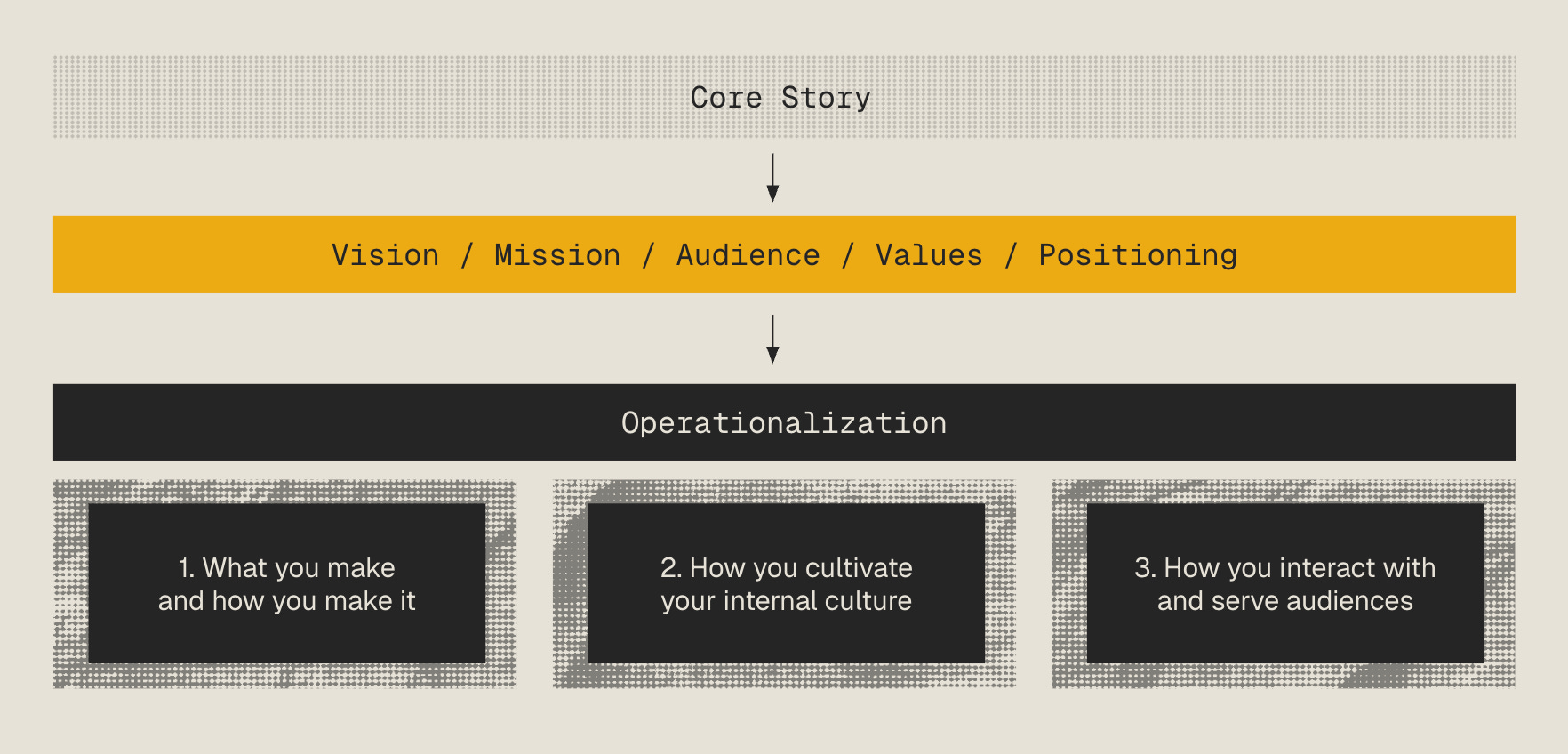
Upstream brand strategy is the work of building a macro brand story and framework – rooted in a company’s strengths, competitive advantage, cultural contexts and truths about the people they serve – to drive all company activity.
It starts with the brand story. As much as I can, I use the Hero’s Journey to co-create that story with my clients (reality: sometimes I’m walking into situations where their culture has another way of doing this, so I flex to that).
That Hero’s Journey process is another post for another day, but I do that exercise to honor a primal truth: we are species that are hard-wired to navigate the world through stories, so for an entity to be successful, they need to tell a brave, motivating core story.
With the story in place, I work with my clients to build a brand framework. Each client will have a different brand framework influenced by their legacy artifacts and culture, but here are a few elements that I believe in when it comes to constructing the frame.
A vision (if you’re wildly successful, what change do you see in the world)
A mission (the work your organization does to achieve the vision)
An overall audience (the kind of people you serve)
Your values (what drivers and motivations define your company’s work)
The positioning (what space you’re going to claim in the marketplace)
This story and frame - it’s hella important. The foundations created by the core story and frame can serve as the glue and guides for an organization, creating clarity, galvanizing the work and creating efficiencies. And great leaders do not become great leaders without a rallying story for people to believe in and follow - so this work is really important to an organization’s success.
During an earlier phase of my career, I would deliver everything we just talked about and be really impressed with myself, my team and the collective genius that we bestowed upon our lucky clients. We go get a drink and congratulate ourselves for changing the client’s business. And then a year later, we’d realize that for the most part, our work didn’t do jack shit.
Because the story and the frame is the easy part of the process. Seriously.
And side note, if we’re being honest, it’s the part of the process that AI will gobble up first in our discipline.
Let’s talk about the hard part: brand operationalization.
The story and framework is the sprint; operationalization is the marathon.
Powerful organizations operationalize the strategy in three ways:
What you make and how you make it (think product, supply chains)
How you cultivate your internal culture (think recruiting, policies, performance, rituals, retention)
How you interact with and serve audiences (think brand assets, engagement ecosystems)
This operationalization means working with how the business works and what is truly incentivized in an organization. It’s being tuned to the power dynamics of individuals, teams, goals and investments to create momentum. It means figuring out a way that just about everyone and every team will win through embracing the brand work.
What this practically means is getting into the guts and people and culture and politics of an organization, working team by team, sometimes person by person, via multiple meetings, workshops, debates, iterations and ideas to take the theory of the brand and apply it to the day-to-day work of the organization.
It’s driving change when change is something that is often mightily resisted within organizations, especially by the power brokers who are doing just fine thank you very much but whose buy-in is critical to success.
I find this work fascinating but, let’s be honest, it can be intensely difficult.
Here are some things that make it easier:
Leadership mandate
Honestly, without this I don’t know how this work is successful. This idea that a brand team that’s a couple levels down in an organization will shift that organization through influence is batshit crazy and sets up really good people to flail and fail. For this work to work, leaders, especially the CEO, need to build it into their mandates and be loud about its importance. Otherwise there is always a reason to push aside the “fluffy emotional storytelling brand work” in favor of the realities or even emergencies that are right in front of an operational team.
System savant
You need a client counterpart that has the following wondrous combination: highly motivated to implement the change in the system AND a master of the system. What this practically means is having a day-to-day partner who has been there for a long time, worked in many areas of the organization, who knows just about everyone and knows where the battles have been fought and bodies are buried.
This is especially necessary in big, legacy companies that have twisty structures and palpable politics, which is inevitable whenever a company scales.
Work with what’s there
What doesn’t work? Slamming into an organization with my own frameworks of implementation. Instead, to make operationalization really work, I have to orient my own energy into the “facilitator/co-creator” space and stop trying to be some fantastical “brand genius”.
This means learning the company’s existing frameworks and workflows and working the brand operationalization through them, versus bringing in new, shiny frames that are supposed to work in addition to them.
Now, sometimes you genuinely need a new framework for a company to follow. In that case, they need to be developed collaboratively with internal teams. Because new shiny frames that aren’t collaboratively developed with the client don’t really work.
To sum it up…
Every successful leader and organization needs a story that gets powerfully optimized. Brand strategy is a profoundly effective discipline to get that story articulated.
Operationalization is where the integrity is in this work. It’s one thing to deliver a beautiful brand strategy in a handful of gorgeous slides, slides that can often accumulate the proverbial digital dust. Operationalization is where that brand work gets pressure-tested, applied and shows real value to the clients.
But it’s not easy. Get executive sponsorship, and internal navigator and ride the balance of humility and strength in working it through with the internal teams.
But it’s worth it. Because when it works (and I’ve found that this can work from Fortune 50’s to community-driven non-profits), it clarifies, it energizes, it drives transformation.
Until next time…
Delicious! My favorite kind of brand strategy! Wonderfully articulated.